Syria: FSA commander calls for international support - YouTube: ""
'via Blog this'

The Struggle For Freedom, Justice and Equality
Thursday, October 11, 2012

Thursday, October 4, 2012
Thursday, September 27, 2012
» “One Does Not Live as One Knows, but as Time Demands” Gadaa.com Oduu – News
By Ibsaa Guutama* | September 2012
Though not a fundamental one, a symbolic change is taking place in the Ethiopian Empire. A famous kingdom of Wala’ita was destroyed; its leaders wiped out; and its population reduced to less than half of what it used to be from death and enslavement by Habashaa invaders a hundred years (1894) ago. Those enslaved were turned into pack animals to carry goods, and mills to grind grain for the army that continued to invade other lands. Their women, in addition to the labor assigned for them, were also used as gratifiers for the gun wielders. Many were sold in domestic and foreign markets, and converted to cash. Those enslaved had also a great contribution in building the invaders’ palace founded in 1886 in Oromiyaa, another new colony. Today, one of their sons is going to make that palace his dwelling and be their king, and a commander-in-chief of the modern version of that army without forging a spear. Like they made his ancestors prostrate, they are also going to prostrate in front of him.
His religion is one they refer to as “Kinishaa” (derogative for Protestant) with contempt or “Tsera Maariam” (anti-Mary). Even if he is de facto their puppet, de jure, he is their highest king. Nothing could move without his signature. It is not hard to imagine what impact this would have on the psychology and morale of the chauvinists. Since he is yet a tool of oppression, no benefit will come out of him for the oppressed. But, the symbolic victory to be gained by that – will not be simple. Some say because there is the hidden hand of “Xosso” in it, no one can reverse it. They believe that even the money TPLF plundered and piled up, and the network it laid down to ensnare other peoples cannot bend that hand. Like it is said, “That who abuses the destitute cannot become rich.” Even if the hand of “Xosso” or other is not there, the catastrophe that is approaching darkening does not seem to turn back. Maltreatment has reached to peoples’ necks.
What are happening now are different from the past. Though past Habashaa kings were not themselves Habashaa, their origins were highly confidential. For that reason, they used to tag them to Solomon. Before the composition of the Darg was known, it was rumored that their chief was a “Walaamoo.” Even after they were made public, except for the leader’s color being dark, his origin was never mentioned though the onlookers assumed him to be anything they liked. It was tried to make him a son of Minilik’s illegitimate son. After all were gone, the question, “were not the emperor as well as Darg’s leader Oromo?” started to be asked? All that was to say that, since Oromo had contributed leadership for the empire over a long period, they have no right to ask for independence. They know in their hearts that Oromo had never joined them as a people, except as captives, servants and assimilated individuals.
Tigrawayi did not bother to insist on false evidences from history. They tried to mold changes that seemed all-inclusive. First, they said “federal.” Now, they are talking about equal participation in the party. With that, the son of southern peoples, in particular, that of a Wala’ita, has publicly mounted onto the saddle. There is also a fake election surrounding it. All the colonies are in it by a pretentious election. They want to claim that their party is all-inclusive. Still, the system is what the colonizer has laid down for itself. It does not work for others, except for themselves. Many may say that one who mounted has no own personality, except identity to console themselves. The system has decayed; how far the present maneuver can buy it life is not known. But, unless the rights of peoples to national self-determination are publicly recognized and implemented peacefully, what has decayed could suddenly fall apart, and cause more damage.
To benumb liberation movements of the peoples, Wayyaanee had gathered and created for all an organization it called “People’s Democratic Organization,” and declared EPRDF as a coalition of equals. In there, the Southern peoples, Oromo, Amaaraa and Tigrawayi have one organization each. It means on paper south and north has equal voices. That they may not question its authority in the course of time, TPLF entangled them in a system and laws denying them harmonious relations by continuous assessment cessions. Despite that, the others are starting to come forward by utilizing the same system it laid down. True power lies with one that has upperhand on the economy and control mechanisms. For the time, that is Wayyaanee. Whether to dodge hate piled for twenty years or because the rein has fallen from its hand, it has stepped back. It is said that, even most of the economy is in the hands of individuals whom only Mallas knew. What is known in the name of the organization is considered not even to be able to foot credits. It is not known if there is other force behind what is going on at present. For the time, the struggle going on in the oppressor’s camp is covered in mist.
An empire with Habashaa body and non-Habashaa soul is springing forward. The colonial system is trying to refresh itself in that way. The camp of liberation activists is also expected to come up with a matching transformation – if it has to reach its goal. Otherwise, the colonizer tries to transit from era to era with clay shoes that seem strong hiding weaknesses that befall it. Direct enemy is not the people from whom those who constructed the empire system originate, but the system. Be it Amaara, Wala’ita, Oromo or Anyuwak – whoever is at the head, the empire is simply an empire. Oromo in EPRDF do not feel that. Still, they are not released from Mallas’s voodoo. Even now, they did not demand voice that matches the people they pretend to represent.
Solution can be found only if the empire system crumbles. It is like what is said, “changing stoves does not make sauce more palatable.” If a snake molts its skin, it only loses the old one for a new, but it remains a snake. It rather becomes fresher. For this reason, whatever is to be done has to be done before it grew stronger. It is said, “rather than jumping on and snatching away dogs trail after cattle with loose horn hoping that they drop for them.” There are those that are tempted by that in the camp of the oppressed. They never visualize rallying their people and snatching away what belonged to them during the weakness period of the transition, but rather follow them meekly salivating. It needs to be a revolutionary to think in that way.
The time we were born, the time we grew up and the time of our old age had all differences. Technology, human knowledge, climate, etc. will slowly go on bringing about change. It is possible that development and growth that come with time may bring positive or negative change with them. All that could have influence on one’s outlook. If change is dragged, it may invite revolution. By change, it is meant that, when in society, something that is different from the known way happens. It is like the one where a non-Habashaa becomes the head to the “Christian Island” without his identity being hidden. As one knows an empire in which only Habashaa is the head. A social condition is a meshed up web where change comes in turns. The desire of a human being for independence, freedom, peace and justice will not be satisfied by changing faces of the oppressor. It rather continues to sharpen its methods in order to go on surviving.
When coming to the struggle for independence and freedom, we do not look at it differently from possible changes taking place in society. Whether change comes slowly or in a revolutionary way, it is to negate stagnation problems in society. That is something that comes naturally or hastened by leadership. When one says ‘live according to the times,’ it means to compete with change that occurred as not to be overtaken by stagnation. Since there is no growth in stagnation, society has existed carrying out a never-ending change to accommodate the coming new generation. For this reason, to move leaving space for others is a natural order. Lack of that could create chaos. Chaos serves no one sane purpose.
No reason can hinder struggle for survival. Life is a life of competition. Those who are prepared overcome it. Time, that comes changing, demands more strength than the previous. Many peoples and civilization in the world were wiped out or swallowed by the powerful. Those that survived destruction so far are those that had strong systems and are ever prepared to face what comes and save their identity. Oromo was one among those. It came so far falling and felling, falling and springing up. It is one that has strength that could save oneself. Had the gene of the Gadaa system not remained in Oromoo,Oromummaa could have been lost so far. All are hurrying up to wipe out that from Oromo.
It can be observed that, in the world, the desire to enrich oneself by consuming the other is getting more aggressive than ever before. To look at it silently will have without doubt fatal repercussion. If the Oromo chose to look at that silently, they may exist not as self sustaining nation, but as downtrodden individuals for the time. Soon, they will not have country, language, history, culture and tradition to refer to. That could be learned from some Oromo tribes in the north. But, if they pull all the courage and defend themselves with determination, the opportunity for survival is immense. Self-defense is blessed by all situations, religion and laws. Even if activists of that time are now aging, the Oromo struggle that commenced four decades ago is still young. It should not be surprising, if there are among them some, who are fed up of the long journey. But, if patriotic activists and the young generation start disarming before the questions that released the struggle got answers, then only could it be worrisome. With that, Oromo survival as a people could come under question.
Those against whom the struggle is being waged still question if Oromo have any claim against them. They are rather seen planning for more sinister move to extend their rule over Oromia for eternity. There are among Oromo activists, who ignited the fire for the liberation struggle and who said to them “had you understood the question we raised, you would have known that they were not meant to separate us; forgive us if it appeared that way, and let us plan together on how we can be accommodated in your grand plan.” It does not even seem if they have arranged for a fallback if they refuse accepting their apology. Is this what they say, “Do not stand by, but join in plundering of your father’s house?” or is it contempt for oneself?
Many saboteurs were born in the process of the struggle. For over a hundred years, they kept the Oromo people apart. They divided Oromiyaa into several regions convenient for their purposes. They scattered Oromo tribes that were its pole and rafters over those regions. Regions, tribes and religion that were strong for generations – now became their weak joints. They have to go back to situations before they were occupied, and look into how these differences served as strength and Oromize their outlook. Otherwise, looking at the self and each other with alien spectacles will blur their sight.
Regions in which they find themselves are those that aliens divided them into and not something they made for themselves, so cannot be things to brag or be proud about. Oromo tribes are still foundations of their unity. That means they are their poles and rafters. Oromo nation is the top most structure, its pillar and roof that knots them all together. Tribalism is not something that competes with nationalism, but strengthen it. Concerning religion, Gadaa system had already laid out on how harmony could be achieved. In the past, Oromo had only one religion. Even then, religion does not interfere in the affairs of politics, and vise versa. That was how the forefathers of Oromo kept religion and governance apart. The present generation has a lot to learn from them.
Oromo is one nation. Being one does not guaranty having unity. Unity is to be wholesome and show integration with harmony knowing, but not exaggerating, existence of differences. Required unity is the unity of kaayyoo, the unity for defending one’s country and people from evil. The love of one’s country must be expressed from the heart, not from the mouth. That would be realized when one starts to look at the self, at each other and at the world from the Oromo perspective. Oromo had ethical standards, lines not to be crossed in internal and external relations. In the independent Oromiyaa, the laws of Waq and those of men enforced them. Now, they may need social pressure and volunteers to be reintroduced and enforced.
Oromo have several political organizations. It will be a mistake to see those or cause to be seen same as none existent. To run away from strengthening those that are already there and try to suggest coming up with a strong new one is unlikely. The brain and experience are those that built, but unable to pull it down or prop it up. The seeming weak that different problems hindered from leaping forward have only a temporary glitch and will overcome soon. Like it is said, “Broken pieces are together wholesome.” They can make it faster if they rise hand in hand. That is likely.
Habashaa elites can no more hold the empire – as it used to be. For now, they have chosen their commander-in-chief with own identity from their colonies for the first time. Though fake, it has a symbolic significance for the region. What TPLF started as “federal” to disguise the nature of the empire state, without changing its structure and function, now has crossed to political party. They are coming out declaring one whom peers voted for in the party can rule the country irrespective of the national origin. But, that cannot change nature of the state. There coming that far indicate their understanding of problems going to engulf the region. They know that, for the enslaved, the change that started cannot be stopped until the empire state is dismantled. “One does not live as one knows, but as time demands” is a saying with great depth that came down from Oromo forefathers. It is required to wait prepared to catch what the time hurls. To be active – so as not to miss for laziness the opportunity that time holds can save one from extinction. When Oromo enemy comes out with changed tactics and strategy, unless one meet it with matching organization, counter tactic and strategy, it would be extending agony on oneself. It should not be forgotten that assumed weak joints that the enemy tries to poke at are also each others strength. To understand Oromummaa together and see problems ahead with one eye, it is wise to go back and search for solution in the Gadaa system. Oromo is one; it is a people that have one language, one history, one common base for culture and tradition, and one common source of oppression. So far, no Oromo has come out denying this. What is mixed up is the inability to fix in common the standard of good and evil, honor and humiliation. An enemy for one is seen being friend for the other. If they cannot differentiate that together, they are bound to be enemy to each other. That is happening because their source of reference is not their own, but one that aliens kept aside for them. Oromo civilization is different from others. To use that, it is essential to go back to one’s civilization roots and research. The panacea for doubting and wavering could be found there. In a struggle, there could be no alternative with success to commitment and determination.
Honor and glory for the fallen heroines and heroes; liberty equality and freedom for the living and nagaa and araaraa for the Ayyaanaa of our fore parents!
* Ibsaa Guutama is a member of the generation that drew the first Political program of the OLF.
Source: Gubirmans.com
Friday, September 21, 2012
Future of Occupy one year after
One year ago, a park in New York was taken over by a band of urban survivalists driven mad by the systemic causes and consequences of wealth inequality in America. The occupation and its message were so resonant with the world outside this park that within two months it exploded into a global brand of dissent that rivaled the Arab Spring. It hit its apex quickly; over the course of the winter, fed-up city governments and the elements took their toll on the biggest encampments across the nation. For the better part of the last year, dozens of media outlets have taken turns pronouncing the movement over, with estimated times of death varying from last November to a week ago. Yet this week there were signs of life.
--------
--------
On Monday, I woke up at 5 a.m. to join one or two thousand people who descended upon New York City's financial district for "S17," a celebration of Occupy Wall Street's one-year anniversary. The day was split between guerrilla protests, general assemblies, and general revelry. There seemed to be one police officer for every two protesters posted all over the southern tip of Manhattan, and most had a kind of grimness to them that suggested S17 was in all likelihood going to be the next 9/11. But in fact, as is typical for the model of direct action protests that Occupy often champions, the actions for the day were mainly about making a nuisance of ourselves -- clusters of hundreds of predominantly young men and women clogged up streets, held up intersections and made a ruckus. The clusters regrouped near the Wall Street Bull around lunch time, during which people spoke through the human microphone about poverty, social stratification, debt, climate change, the need to protect the commons and a host of other issues that will never be approached during the election debates; someone announced herself as the first formerly homeless woman to ever run for president; and an Elvis-like street preacher who goes by the name Reverend Billy provided a brief sermon on the need to "choose life" and the environment over an economy centered on Wall Street. After recapping the morning and a bit more organizing, the afternoon involved a second wave of protests and attempts to block streets. In the evening, most the protesters reconvened in Zuccotti Park, the site of the original occupation, for the "Popular Assembly," intended to be the first of a series of weekly meetings, and presenting itself as an alternative to indefinite occupation. Just like most meetings, the Popular Assembly quickly became tedious, and many scattered across the park sharing stories and dancing around drum circles through the night.
By the standards of disrupting business on Wall Street, S17 could not be called a success. This is in large part because NYPD is adept at protecting capital. The police used metal barricades, buses, dogs, helicopters and motorcycles to prevent protesters from entering the places where they were to execute the major planned act of civil disobedience of the morning -- a "human wall" that would block people from accessing the New York Stock Exchange. When the roving, autonomous clusters of protesters tried to make life difficult just outside this protected zone by blocking intersections, the police would take a few minutes to realize what was happening and end it through bursts of extraordinary violence and arrests (the day ended with nearly two hundred). There was no disobedience of consequence, and life went on in the area fairly normally, albeit if slightly more slowly.
What was striking about the police charges at the nonviolent troublemakers was how forcefully they showed that concerns about public safety were not guiding their conduct. For instance, a teenager running back and forth across West Street, threatening to stay on the road even when the traffic light changed, was brought into custody by two cops who appeared to be training for the NFL. His entire face was covered in blood. When a skinny young woman chucked an empty plastic soda bottle at a police officer after he pushed her on the sidewalk, she was smashed face-first into the street by no less than four large men. Her entire face was covered in blood. The list goes on and on; I witnessed at least eight such sanguinary incidents myself, and only one of them involved direct provocation in the form of the aforementioned thrown object. This is entirely ordinary for non-state approved protests in America, but it is not something that one gets used to.
Most intriguing of all, there was a near-total arbitrariness at play in many of the arrests. Often when there was a gray area in the legality of occupying a certain space, the police would simply pick off the slower or bolder people like sharks chasing a school of fish. Other times people were randomly grabbed and stuffed in a police bus while marching legally on the streets. (One theory being circulated was that the totally random arrests were for activists who had an established reputation of some kind.) This was something nearly everybody I met spoke about. The genius of this policy is that since one does not know precisely which behavior one has to avoid to be arrested, everybody grows more timid -- even those who do not mind being arrested don't want to be tackled or taken out of action without good reason. By fencing off critical junctures, exercising disproportionate force, and arresting people whimsically, the city was intent on not even allowing for the existence of the spectacle of disobedience.
Introspection
But history shows that people can perform direct action effectively even when the tactical odds are stacked against them by authorities. The reality is that there are massive limitations to organizing many people with decentralization as a group's crowning value. Aside from the "human wall," there were no fleshed out back up plans. What if instead of being fragmented into dozens of free-forming groups, all the Occupiers targeted one bank or one intersection simultaneously? Would the police really have arrested everybody? (Unfortunately that is a sincere question.) What if all the most risk-inclined protesters formed spearheads for a few coordinated clusters, so that the police didn't just pick them off easily one by one? What if everyone wasn't waiting for someone else to take a stand?
There was a point toward the end of the night in Zuccotti Park (which was gated and had only two exits) where a large group of police officers in riot gear stormed into the park. There was a ton of commotion; most people flooded out of the park, and those that remained within it surrounded the police wielding a variety of cameras, expecting to capture them doing something inappropriate. It turned out the police were looking for tents, and not much else. As the police filed out of the park, a young man from Chicago leaned over and told me that everyone in Zuccotti was waiting to watch somebody else to do something worth watching.
In fact the city he hailed from exemplified this tendency earlier this year. The much-hyped resistance to the NATO Summit in Chicago -- a conference that at one point looked like it might've been the site of the next Battle of Seattle -- was a crippling disappointment for Occupy. While it is true that Rahm Emanuel loves war and raised over $30 million for security, the major march of the weekend didn't even come close to materializing into anything substantially more than that, despite the biggest American black bloc contingent I've seen in years.
Occupy's dominant models for direct action, with roots that can be traced to autonomist Marxist and anarchist repertoires of ideology and tactics, is predicated on a laissez-faire view regarding the ideal settings for human enterprise. Occupy, in New York and also within any of its chapters, has a subtle, informal and self-effacing network of leaders who trust people to come to the best organizational solutions for their cause with only minimal external input. More radically, there is an assumption that action is best carried out "spontaneously." This combination of organizational minimalism and reliance on spontaneity establishes a firm ceiling over the possibilities of its collective action. Occupy's faith in the swarm, which has been tested for decades by an eternally hopeful global justice movement that rarely makes concrete gains in America, is increasingly becoming indefensible. The anonymity of the swarm allows people to evade responsibility and become a spectator within a mode of politics whose essence is participatory. Seattle is the exception to the rule.
Staying alive
But Occupy is far more than the autonomous and spontaneous ethos that informs its approach to direct action. The tents are gone, but its ability to unite people with disparate backgrounds and different utopias for contentious collective action remains unrivaled. It has created hundreds of offshoots that apply direct democratic organizing principles and its critique of political economy to campaigns on particular issues ranging from gentrification to reforming the SEC. Most the media who declare Occupy dead don't pay attention to extrainstitutional politics except when they have to. They don't realize that the modern progressive activist class spends most its time underground trying to make do with very little, and that Occupy's organizational structure is a Swiss Army knife. Times have been hard, and they still are. Let's see what happens.
At the end of the day though, there is something inimitable about the kind of communitarian environment Occupy creates when it manages to hold a space. On Monday I spoke with an Armenian American scrap metal collector about the French Revolution; a Brooklyn councilman about legislation to end New York City's notorious stop-and-frisk policy; Chicago photographers about how to counteract the shuttering of mental health clinics; and a UC Davis student regarding Facebook's impact on horizontal organizing, to give you a sample. This was not idle chatter with hippie vagabonds -- it was strategizing with people who work, and get off work to grind some more. Contrary to the popular rendition of Occupy as a big carnival, most the activists I am personally acquainted with who support Occupy make more time for community and politics than leisure -- or they view all three as the same thing.
But the fact that Occupy cultivates vibrant social scenes doesn't undermine its seriousness -- it ensures its effectiveness. Midday when we were exhausted from the morning runs, someone offered me some food, someone leaned against my body for support without asking permission, someone helped me get up, someone gave me a book, someone drew me a map, someone gave me their email address, and someone wanted mine. Everyone was kind to each other. Reverend Billy yelled out "Mic check" -- the signature Occupy phrase any individual may cry out to get everyone in the crowd to turn to them and echo their words -- maybe three dozen times during his sermon. He called it praying. He was ridiculous and jovial, and I don't think he's a real reverend, but I swear for a moment I was a believer.
The piece originally appeared at THE NEOPROGRESSIVE.
Monday, September 17, 2012
Changing fortunes in Ethiopia’s Ogaden - Features - Al Jazeera English
Wracked by war, insurgency, and famine, the government has launched development projects after years of neglect. Mohammed Adow Last Modified: 17 Sep 2012 11:31 | ||||
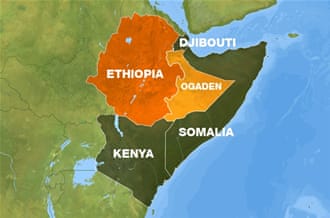
| For as long as its people can remember, cycles of drought-induced famine and underdevelopment have plagued Ethiopia's eastern Ogaden region. One of the least developed corners of Earth, the people of Ogaden often joke that "if Adam returns, he will definitely recognise our land".
Ogaden’s recent history is also clouded by conflict that has killed thousands. Ceded to Ethiopia by the British in 1954, Ogaden has twice been fought over with Somalia, which claims the region as its own. And for the past two decades, the Ogaden National Liberation Front has waged a rebellion, fighting for secession from Ethiopia. As a result, there has been heightened military activity in Ogaden in recent years. Tens of thousands of Ethiopian troops and special counter-insurgency police have been deployed to fight the rebels, but also to secure the border and counter what is perceived as a threat by Somalia's al-Shabab militias. The last thing Ethiopia wants is trouble along its long border with Somalia, and it is wary of further unrest being stoked among its ethnic Somalis. Nomadic life Ethiopian Somalis are traditionally nomadic pastoralists, and have been so for centuries. Life and survival revolves around livestock, with people constantly moving about to feed their animals. But as a result of increasingly frequent drought and chronic overgrazing, the region is facing serious environmental degradation. There are attempts by the government to turn the nomads into agro-pastoralists -to settle and grow crops while still tending their livestock. But poor rains continue to hamper these efforts, too. Near Qabribayah town, 50km outside the capital, Ahmednoor Abdullahi and his younger brother use their only camel to plough their small maize farm. Seventeen members of their family depend on the farm, about a quarter the size of a football pitch. "We did not get a harvest during the last season, our crops failed," says Abdullahi. "Life here depends on rainfall. Most people moved away with their livestock, but we chose to stay and wait for the rain." Ogaden’s barren land is littered with remnants of past conflict, including dilapidated military equipment such as rusted tanks and armoured-personnel carriers. Jijiga on the rise Jijiga, the regional capital, is a jumble of villages with a sprinkling of administrative buildings, shabby hotels, a busy market and a military base -all intertwined by countless mud houses with corrugated-tin roofs. Many people who fled the hinterland and the battlefields have sought refuge here. Big 4x4 vehicles share the streets with squeaky horse-drawn carts that act as taxis. Nomads drive their herds of camels down the roads. At midday in Jijiga, the temperature can rise to 35°C. The men have taken to chewing khat, the leafy narcotic brought from the Ethiopian highlands. A visitor would be surprised by the sudden commotion on the dusty streets as a cacophony of car horns, screeching brakes, and shouting herald the happy news that the khat has arrived.
In the afternoons, Jijiga becomes a ghost town, abandoned to the camels and cats. Locals are firmly ensconced behind closed doors in the confines of the mabraz -the khat den. Here, people recline on cushions, smoke cigarettes and sip sweet tea while chomping on the stimulating leaves. Later, after the drug takes effect, lively debates break out. From their conversations, it is clear most Ethiopian Somalis feel culturally and socially closer to their kin in Somalia than they do with the Ethiopian highlanders. Economic ties to Somalia On the economic side, Ogaden’s trade with and through Somalia is many times greater than that with the rest of Ethiopia. The Somali shilling is the main currency in some areas of Ogaden. With the Somali border just 30 minutes away by car, smuggling flourishes. Rice, sugar, utensils, furniture, and even industrial machinery are brought into Jijiga in the dead of the night. Security checkpoints do nothing to stop it. Ethiopia’s government has recently initiated numerous development projects, and the sprawling capital, being the most accessible and peaceful in the region, has received the bulk of these schemes. Hundreds of kilometres of roads linking Jijiga to other areas have been constructed. Workers were recently putting the final touches on a multi-million dollar hospital. Named after Ethiopia’s late prime minister Meles Zenawi, it will serve as the main medical facility for the region. But it is investment in the education system that is most profound. At the Jijiga University, 15,000 students are attending 30 faculties. "That universities now stand where used to be frontlines or military bases. It has changed the perception of people about this region," says Sultan Muhidin Odowaa, the university’s vice president. "Unlike before, education opportunities are now available to all." Women, too, are benefitting from the construction boom. They’ve been taught how to pave roads and now can earn a decent living.
Rights abuse allegations Critics, however, say most development projects are limited to Jijiga and few other places. Ogaden’s leader, Abdi Mohamud Omar, says there are reasons for that. "There is no doubt some provinces are ahead of others in terms of growth. There are those you can easily send workers to implement projects, and others that are insecure due to the activities of the rebels," he says. A dearth of skilled manpower, inadequate infrastructure, and an acute shortage of communication facilities also constitute formidable constraints to developing the region. Neglect by previous regimes has not helped. Abdi Mohamud’s administration has been effective in bringing security to some parts of the volatile region. He created a special unit of counter-insurgency police, which now forms the backbone of the region’s security apparatus -so much so that they’ve replaced the Ethiopian army in fighting the rebels. "For any force to be effective they have to speak the language of the people they serve, and belong to their religion and culture," says Abdi Mohamud. "It became necessary for the regional government to face head on its security challenges -hence the formation of the Liyu police." Human rights groups, however, accuse the Liyu of engaging in serious abuses against civilians, including allegations of extrajudicial executions and torture. "The Liyu police … fit into the context of impunity where security forces can more or less do what they want," says Laetitia Bader, a researcher with Human Rights Watch. It is a claim the regional president denies. "Human Rights Watch should be impartial," Abdi Mohamud says. "They usually peddle lies and propaganda from our opponents around. They should also examine the atrocities being committed by the rebels." With tight controls imposed on access to Ogaden for independent journalists and aid workers, it is difficult to confirm these claims and counter-claims. This month the Ethiopian government and the Ogaden National Liberation Front rebels announced they had commenced peace talks in neighbouring Kenya. But until these negotiations result in a formal agreement, lasting peace in the Ogaden desert will remain elusive -as it has for the past 50 years. |


Sunday, September 16, 2012
Subscribe to:
Posts (Atom)