Tuesday, May 5, 2015

Israel must eliminate racism - PM Netanyahu - BBC News


Media captionThe BBC's Kevin Connolly reports on the aftermath of the protests
Israel's prime minister has said racism in the country must be eliminated, after protests by Ethiopian Israelis against alleged discrimination.
Benjamin Netanyahu spoke after meeting Ethiopian Israeli community leaders and an Ethiopian Israeli soldier, whose beating by police has fuelled tensions.
A protest by Ethiopian Israelis on Sunday ended in clashes with police.
Israel's president said the community's grievances "revealed an open and raw wound" at the heart of Israeli society.
"We must look directly at this open wound," Reuven Rivlin added. "We have erred. We did not look, and we did not listen enough."
At least 46 police and seven demonstrators were hurt in the clashes which followed the protest in Tel Aviv on Sunday night, officials said. Dozens of protesters were arrested, police said.

Call for unity

On Monday, Mr Netanyahu met Israeli soldier Damas Fekade, who was beaten by two police officers in a suburb of Tel Aviv last week.
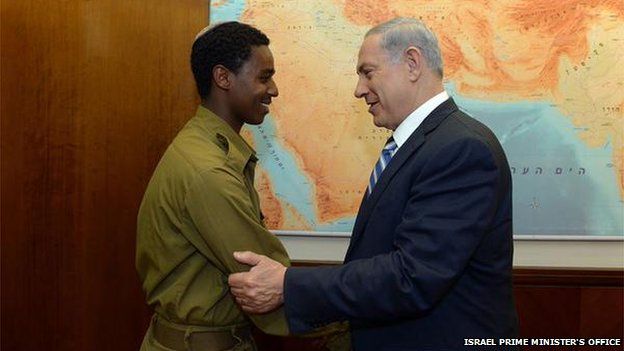
Damas Fekade (left) with Benjamin Netanyahu (04/05/15)
Mr Netanyahu met soldier Damas Fekade, who was beaten by two Israeli policemen
The prime minister praised Mr Fekade and told him he had been shocked by thevideo of the beating.
Afterwards, Mr Netanyahu met Ethiopian Israeli leaders in an effort to reassure the community.
"We must stand together as one against the phenomenon of racism, to denounce it and eliminate it," he said.
One of the policemen involved in Mr Fekade's beating has been dismissed and the other suspended from the force, Israeli police spokesman Micky Rosenfeld told the BBC.
An investigation into the incident is under way.

Tear gas

The protests on Sunday started peacefully but became more violent as night fell.
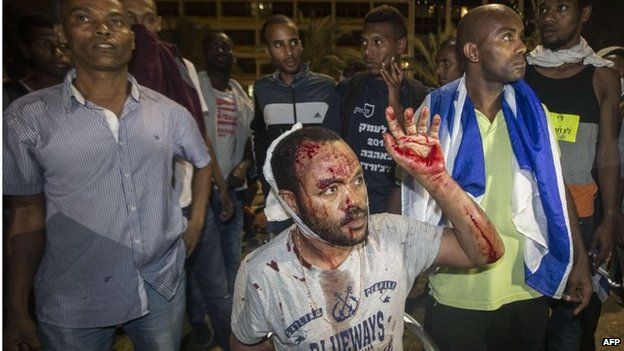
Wounded Ethiopian Israeli
Dozens of police and protesters were injured in the clashes
Some protesters threw stones, bottles and chairs at police and tried to enter the Tel Aviv municipality building.
Police fired tear gas and stun grenades and officers on horseback charged the crowd to try to disperse it.

line

Analysis: Kevin Connolly, BBC News, Jerusalem

President Reuven Rivlin was quick to respond to the weekend's disturbances with calming words - the country hadn't listened to its Ethiopian minority, he said.
It is listening today at least.
The police used considerable force to disperse the rioting crowds in Tel Aviv but the government is seeking to send a simultaneous signal that it recognises the strength of the Ethiopian minority's grievance about racism and discrimination in jobs and education.
It is an awkward twist in what began as a triumphant story for Israel which began with one of Zionism's most exotic initiatives - a series of airlifts dating back to the 1980s which brought to Israel members of a religious minority with Jewish roots.
As black migrants from a country with a poorly-developed educational system, though, they have struggled to integrate into Israeli society and they have been left feeling that their treatment has never quite matched the imagination and generosity of the impulse which brought them here.
line
Ethiopian Jews living in Israel have long complained of discrimination, and similar protests in 2012 followed reports that some Israeli landlords were refusing to rent out their properties to Ethiopian Jews.
Ethiopian Jews' income is considerably lower than the general population, and they are much more likely to face limited educational opportunities and to end up in prison, according to The Ethiopian National Project, a non-governmental organisation which assists Ethiopian Jews in Israel.
Tens of thousands of Ethiopian Jews were airlifted to Israel in secret operations in the 1980s and 1990s to escape famine and civil war. There are now around 135,000 Ethiopian Jews living in Israel.

Monday, May 4, 2015

Ethiopian Israelis: 'A community crying out' - CNN.com


Ethiopian Israelis: 'A community crying out'


Protests erupt in Israel over viral video

Protests erupt in Israel over viral video 02:38


Story highlights

  •  Soldier ID'd as Cpl. Demas Fikadey, 21; he has lived in Israel seven years
  • Ethiopian Israelis have struggled to integrate after their arrivals in recent decades
  • They feel they are being racially profiled by police, an Israeli professor says
(CNN)The clashes between Ethiopian-Israeli protesters and police over the weekend have drawn international attention to one of the most disadvantaged groups in Israel.
Though the demonstrations were set off by the police beating of a uniformed Israeli soldier, captured on video, experts say the issues between the Ethiopian-Israeli community and the government are not new ones.
"The protesters, in Jerusalem and in Tel Aviv, revealed an open and raw wound at the heart of Israeli society," Israeli President Reuven Rivlin said. "The pain of a community crying out over a sense of discrimination, racism, and of being unanswered."
But who are the Ethiopian Israelis, and what are their grievances?

Most arrived in recent decades

    Many Ethiopian Jews came to Israel in two large waves of migration in the 1980s and early 1990s after the chief rabbinate of Israel recognized them as Jews in 1975. Their ancestors had lived in Ethiopia for thousands of years.
    Some of the Israeli efforts to bring Jews from Ethiopia involved high stakes, such as the clandestine Operation Moses in 1984. The arrivals continued until 2013 when Israel ended the program of mass repatriations from Ethiopia.

    They have struggled to integrate

    After the sudden transition -- often from rural villages in Ethiopia to developed Israeli towns -- a lot of Ethiopian Israelis have found it difficult to integrate into society. "Many Ethiopian Israelis knew how to read and write before they arrived, but there were others who had never seen a mirror, never owned a pair of shoes, never ridden in an elevator, etc.," says Tebeka, a group that provides legal assistance to Ethiopian Israelis.
    Language often proved a barrier in their new home. "Many of them are from rural Ethiopia, they speak Amharic and dialect," said Joshua Landis, director of the Center for Middle East Studies at the University of Oklahoma. "The vast majority were very slow to learn Hebrew because they were older. The younger generation does, but even 50% of the younger generation don't graduate from high school."

    Economically, they're at a disadvantage

    Today, Ethiopian Israelis make up a small, underprivileged portion of society. They're estimated to number around 135,000, roughly 1.5% to 2% of the overall population. They have the highest poverty rate of any Jewish segment of Israeli society, according to the Ethiopian National Project.
    "They're poor; it's very hard getting jobs," Landis said. "They feel like they're discriminated against in marriage -- many rabbis have refused to marry them unless they go through a symbolic conversion." According to government statistics, 88% of Ethiopian Israelis are married to other Ethiopian Israelis, highlighting their low level of intermarriage.

    Relations with police are strained

    Ethiopian Israelis are particularly upset about their treatment by police. Many of them feel that they are being racially profiled and that police act with a heavier hand with them than with other groups, according to Guy Ben-Porat, an associate professor at Ben-Gurion University of the Negev.
    "Ethiopians believe they're being singled out more than other people," said Ben-Porat, who is studying relations between minority groups and police. "Non-Ethiopians don't feel the same way, except Arab citizens."
    Young Ethiopian Israelis are reported to have far higher incarceration rates than the rest of the population.

    Their anger has boiled over

    The resentment over the police, particularly among young male Ethiopian Israelis, has been around for years. The current anger was set off of by a video that went viral showing Cpl. Demas Fikadey, a uniformed Israel Defense Forces soldier of Ethiopian descent, being assaulted by police.
    Fikadey, 21, has been in Israel seven years and told CNN the military recently honored him for his social work in the community.
    The anti-police demonstrations in Israel have been compared to those in the United States over police treatment of African-Americans. "Both cases are about racial profiling -- people feeling they're being targeted by police because of their skin color," Ben-Porat said.
    The issues also run deeper. "Their frustrations are not just about the police but also the education system, the economic system -- they have lots of grudges," he said. "Police violence is just the trigger; the feelings are about much wider issues."

    Tackling the issues could take generations

    After the clashes between protesters and police Sunday, Israeli Prime Minister Benjamin Netanyahu announced he would meet with leaders in the Ethiopian community as well as the soldier who was assaulted in the video.
    Landis, the Center for Middle East Studies director, said that's a positive sign, but just the start on a long road. "It's going to require a dialogue that goes on for years and generations, as we've found in the United States," he said. "There can't just be a civil rights movement of a few years and it goes away. This is an ongoing problem, and it's very deep-seated. It's socially ingrained."
    The Israeli President appeared to agree in his comments about the situation. "We must look directly at this open wound," he said. "We have erred. We did not look, and we did not listen enough."

    Israel police clash with Ethiopian Jewish protesters - BBC News


    Media captionThe BBC's Kevin Connolly says following the unrest, a delegation of Ethiopian Jews will now meet the Israeli prime minister
    Dozens of police and protesters have been hurt after a protest by Ethiopian Israelis against alleged police brutality turned violent in Tel Aviv.
    Thousands of Israeli Jews of Ethiopian origin had taken part in a rally before some demonstrators tried to storm the city's municipality building.
    Police fired tear gas and stun grenades as protesters threw bottles and bricks.
    Tensions have risen after video emerged last week showing two policemen beating an Ethiopian Israeli soldier.
    Two officers have been suspended and the incident is being investigated.
    Israeli President Reuven Rivlin blamed a "handful of violent trouble-makers" for Sunday's violence but said Ethiopian Jews' grievances had to be addressed.
    The protests, he added, exposed "the pain of a community crying out over a sense of discrimination, racism, and of being unanswered. We must look directly at this open wound."
    On Monday, Israeli Prime Minister Benjamin Netanyahu will meet the soldier who appeared in the video, as well as Ethiopian community leaders.


    Protesters, whom are mainly Israeli Jews of Ethiopian origin, stand next to a garbage bin they set on fire at Rabin Square, Tel Aviv May 3, 2015.
    Protesters tried to storm Tel Aviv's municipality building following the anti-racism rally
    A protester, who is an Israeli Jews of Ethiopian origin, is treated for injury - Tel Aviv May 3, 2015
    Many people, including dozens of police officers, were hurt in the clashes


    'Not prepared to wait'

    On Sunday, protests started peacefully as demonstrators blocked a busy road. Many walked with their hands held together in the air, to signify handcuffs. But the demonstration became more violent as night fell.
    Some protesters threw stones, bottles and chairs and tried to enter the municipality building.


    Israeli policemen push protesters, mainly whom are Israeli Jews of Ethiopian origin- Tel Aviv May 3, 2015.
    Anger has risen after footage of police allegedly beating an Ethiopian Israeli soldier emerged
    A protester, who is an Israeli Jews of Ethiopian origin, shouts at a policeman during a demonstration in Tel Aviv May 3, 2015.
    Israelis of Ethiopian origin have long complained of discrimination and police brutality


    At least 46 police and seven protesters were hurt, officials said. Dozens of protesters were arrested, police said.
    One demonstrator told Israel's Channel 10 television channel: "Our parents were humiliated for years.
    "We are not prepared to wait any longer to be recognised as equal citizens. It may take a few months, but it will happen."
    Tel Aviv police chief Yohanan Danino told Channel 10: "The use of violence by a small minority of the many protesters does not serve their struggle.
    "Whoever harms police or civilians will be brought to justice.''
    Ethiopian Jews living in Israel have long complained of discrimination, and similar protests in 2012 followed reports that some Israeli landlords were refusing to rent out their properties to Ethiopian Jews.
    Ethiopian Israeli Jews' income is considerably lower than the general population, and they are much more likely to face limited educational opportunities and to end up in prison, according to The Ethiopian National Project, a non-governmental organisation which assists Ethiopian Jews in Israel.
    Tens of thousands of Ethiopian Jews were airlifted to Israel in secret operations in the 1980s and 1990s to escape famine and civil war. There are now around 135,000 Ethiopian Jews living in Israel.

    Saturday, May 2, 2015

    Despite executions, drowning, some Ethiopians still dream of Europe | Daily Mail Online


    On the walls of homes in the poor Cherkos neighbourhood of Ethiopia's capital, the portraits of "martyrs" killed in their attempt to enter Europe offer a grim warning.
    The murders of several Ethiopian Christians last month in Libya horrified Ethiopians and sparked global condemnation, including from Pope Francis who expressed his "great distress and sadness".
    At least five of the victims out of the group of 28 migrants on the gruesome video were recognised as coming from this poor neighbourhood in the heart of the Ethiopian capital and its tightly packed clusters of simple brick, tin roof buildings.
    Flowers float into the Mediterranean sea on April 28, 2015 in Nice, France, in honor of migrants who drowned trying to reach Europe

    Flowers float into the Mediterranean sea on April 28, 2015 in Nice, France, in honor of migrants who drowned trying to reach Europe ©Valery Hache (AFP/File)
    "We were about to leave, now we will wait a bit, but not too long," said one young man aged around 20, sitting with friends, all shocked by having watched the horrific executions on their mobile telephones.
    "In a few months this will all be forgotten. But our situation has not changed."
    Sitting on the side of the street and recounting their frustrations, the three young men instead point to the "20 or so" migrants who they say they know have made it to Europe -- to Malta, Sweden, Britain and Germany.
    "They've transformed their lives and the lives of their families," one of them said.
    Ethiopia's economy is one of the best performers in Africa, and foreign investment is pouring in. But without any qualifications, the young men say they have little hope of a good job -- beyond labouring for around 50 biirs (just under $3) a day.
    The way out is well-known: a bus ride to neighbouring Sudan, then the crossing of the Sahara desert to reach the Libyan capital Tripoli, which is 3,700 kilometres (2,300 miles) from Addis Ababa. After that it's a case of finding a boat to Italy.
    In all, the journey coast between $2,500 and $5,000, a fortune but one that most think they can pay back as soon as they strike gold in Europe.
    The lucky ones reach Europe in a few weeks, with Ethiopians declaring themselves Eritreans in order to seek asylum. Some, however, end up stuck in Libya, short of cash. Others simply disappear.
    - 'Question of luck' -
    Baheru Lemme, who runs a church-based youth association, is trying to convince young Ethiopians to stay, but he admits that is a huge challenge.
    "Too many families encourage their children to leave so they can send back some money, rather then invest instead in their education," he said.
    "I tell them about the dangers of the journey. I tell them they can change their lives by staying here and working hard, but they are pessimistic."
    Baheru said that even after the executions carried out by Islamic State militants, two more locals have left for Libya in recent days.
    "I tried to reason with them, but they said that if they die then they'll be martyrs," he said, adding he had given them a Bible for their journey.
    Ethiopia's government is also trying to put off would-be migrants, with measures including tougher laws against human traffickers.
    Not far from where Baheru runs his church group, a funeral was being held for Biruk Kassa, one of the victims who appeared on the video. Among the mourners, family friend Ferek admitted he still dreamt of Europe despite the obvious risks.
    "If I had the money to pay the smugglers, I'd go right away," he said, complaining that at 24 and even as a student of marketing, he believed he had few prospects. In Britain, however, he believed he could earn the equivalent of a monthly salary in a day.
    As for the dangers of the journey, he shrugs his shoulders: "Some make it, others don't. It's a question of luck."
    Migrants stand next to Tunisian security forces in the southeastern port of Zarzis on April 25, 2015, after they were rescued by fishermen while trying to sa...

    Migrants stand next to Tunisian security forces in the southeastern port of Zarzis on April 25, 2015, after they were rescued by fishermen while trying to sail from Libya to Europe ©Fethi Nasri (AFP/File)
    Migrants who were hoping to reach Europe by boat sit at Abu Salim detention centre for illegal migrants in Tripoli on April 21, 2015

    Migrants who were hoping to reach Europe by boat sit at Abu Salim detention centre for illegal migrants in Tripoli on April 21, 2015 ©Mahmud Turkia (AFP/File)