Saturday, September 3, 2011

Ethiopia denies troops killed by Ogaden rebels BBC News

Ethiopia denies troops killed by Ogaden rebels

map

Related Stories

Ethiopia has denied claims that 25 of its soldiers have been killed by rebels in its oil-producing Somali region.

The Ogaden National Liberation Front (ONLF) said it attacked a military convoy escorting the Chinese oil firm PetroTrans on Tuesday.

Twenty-five government soldiers and several of its fighters were killed in the ensuing clashes near the regional capital, Jijiga, the ONLF said.

The group has been fighting for the region's independence since 1984.

The ONLF said its forces ambushed elite Ethiopian troops escorting a team from PetroTrans to an oil exploration site in the region, which it calls Ogaden.

"The liberation army inflicted extensive damage on the Ethiopian troops," it said.

'Chinese camouflaged'

The government said the ONLF's claims were "absolutely unfounded", the AP news agency reports.

Correspondents say the region - where ethnic Somalis are the majority - is largely closed to independent observers, making it difficult to verify the claims of the two sides.

The ONLF warned of more attacks on Chinese-owned companies.

"The Chinese are wearing army camouflages and, as such, it is very had to differentiate them from the Ethiopian army personnel," it said.

"It is the responsibility of civilians to be clearly distinct when travelling with combat military units in order to safeguard their rights."

In 2007, the ONLF attacked a Chinese-run exploration site in the region, killing 74 people.

The ONLF says it is fighting for the rights of Somali-speaking Ethiopians who have been marginalised by the government in Addis Ababa.

Human rights groups have repeatedly accused the government of widespread atrocities in the region.

More on This Story

Related Stories

From other news sites

Friday, September 2, 2011

Ethiopia rebels attack in Ogaden  | ajc.com

Ethiopia rebels attack in Ogaden

The Associated Press

ADDIS ABABA, Ethiopia — Ethiopian rebels said Thursday they killed 25 soldiers protecting a Chinese oil exploration company called PetroTrans.

It was not possible to verify the claims made by the rebels.

Shimeles Kemal, Ethiopia's government spokesman, denied the claims, saying they are "absolutely unfounded." He also said no PetroTrans operations had been affected by any attacks. Ethiopian authorities usually deny claims made by the Ogaden National Liberation Front, or ONLF, which is listed as a terrorist organization in Ethiopia.

The rebels said that 25 soldiers were killed and 'a few' members of the rebel ONLF during Tuesday's skirmish. Abdirahman Mahdi, a London-based spokesman for the group, had earlier said at least three soldiers were killed in the incident.

The soldiers they killed, "were dislodging farmers from their lands ... claiming that seismic lines pass through their farms. Three villagers from the area are missing," said Thursday's press release. Two other villagers had been beaten and left for dead, it said.

Human rights groups have long accused the Ethiopian government of committing atrocities in the Ogaden, which is largely closed off to outside observers.

The ethnic Somali Ogaden region is home to the ONLF, who have been fighting for self-determination for more than 25 years.

In April, 2007, the group attacked a Chinese-owned oil exploration field, killing nine Chinese workers and 65 Ethiopian workers. Thursday's press release contained a warning that there might be another such attack.

"The Chinese are wearing army camouflages and as such, it is very had to differentiate than from the Ethiopian army personnel," the email read. "It is the responsibility of civilians to be clearly distinct when traveling with combat military units in order to safeguard their rights."

Thursday, July 7, 2011

Questions for Sudan amidst South succession

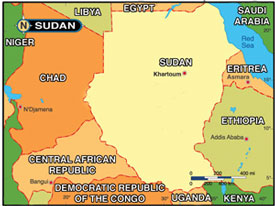
Sudan_Map09-28-2004.jpg
UNITED NATIONS - The news reports concerning Africa's newest nation, South Sudan, seem to change with the wind. But one thing is for sure, South Sudan gains its official independence July 9 and eyes will be on the capital Juba that day, particularly to see if Northern Sudanese President Omar Hassan Al-Bashir shows up.

President Al-Bashir has a warrant against him from the International Criminal Court, issued in 2009 on charges of alleged war crimes, crimes against humanity and genocide for alleged atrocities in the Western region of Darfur. He has categorically denied the charges, saying the ICC is a tool of neo-colonialism. Some are saying the ICC charges were a bargaining chip, used as leverage by Western nations to marginalize President Al-Bashir and to weaken his opposition to secession by the South.

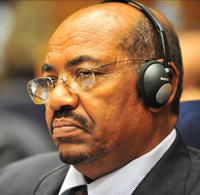
omar_al_bashir07-12-2011.jpg
President Al-Bashir Photo: MGN Online
A referendum vote on secession was a big part of the 2005 Comprehensive Peace Agreement which ended two decades of civil war that began in 1983, between Northern Sudan and Southern Sudan.

UN_Report_bl.jpg
The Sudan Tribune reported June 28 that an official invite had been extended to President Al-Bashir despite threats from Western leaders such as President Barack Obama, French President Nicholas Sarkozy and British Prime Minister David Cameron that they would not participate in Juba if President Al-Bashir was present.

On June 29, the Associated Press reported officials in South Sudan want the U.S. to remove economic sanctions against the North in place since 1997, when then-President Bill Clinton said Sudan supported terrorists such as Osama Bin Laden.

AP revealed the vice president of South Sudan spent three weeks in the U.S. recently in discussions with the Obama administration and ambassadors representing the United Nations Security Council, attempting to get them to realize U.S. sanctions against the Northern regime in Khartoum serve no real purpose today. Since the peace agreement, North and South have shared oil revenues equally, with the lion's-share of the 500,000 barrels a day coming from the South, according to the European Coalition on Oil in Sudan, a group of organizations who say they want to ensure equitable distribution of Sudan's oil wealth.

But, according to the finance minister in Khartoum, the result of the South's secession will be a 36.5 percent drop in revenue. A recent press briefing by a senior U.S. State Department official alluded to the need for agreement between North and South. “They are so intertwined economically that they can hurt each other and hurt themselves very badly, whether it's oil, new currencies, trade or border issues,” said the State Dept.

The official then poured salt on the wound, saying the only path for Khartoum was to find peace in Darfur to get back into the good graces of the international community because the North has “major economical adjustments to make.”

Observers say Washington has opposed Northern Sudan receiving support from the World Bank and the International Monetary Fund as a state sponsor of terrorism. News sources in Washington say the administration is preparing to remove Sudan from its blacklist of nation's sponsoring terrorism, but that is contingent on the Al-Bashir government pulling of its army from the contested border region Abyei.

On June 20, the North and South signed an interim agreement in Addis Ababa, Ethiopia, where the African Union is headquartered, to demilitarize Abyei.

The UN Security Council June 27 passed a unanimous resolution that establishes a 4,200 Ethiopian peacekeeping force known as UNISFA (United Nations Interim Force for Abyei). The peacekeeping force would monitor redeployment of the Sudan Armed Forces and the southern Sudan People's Liberation Army from the Abyei region, roughly the size of Connecticut.

The resolution charges the interim force with facilitating delivery of humanitarian aid and the free movement of relief workers. UNISFA troops would also provide security for the region's oil infrastructure.

Susan Rice, U.S. ambassador to the United Nations, said her government “welcomed the agreement,” but said nothing about lifting sanctions against Khartoum.